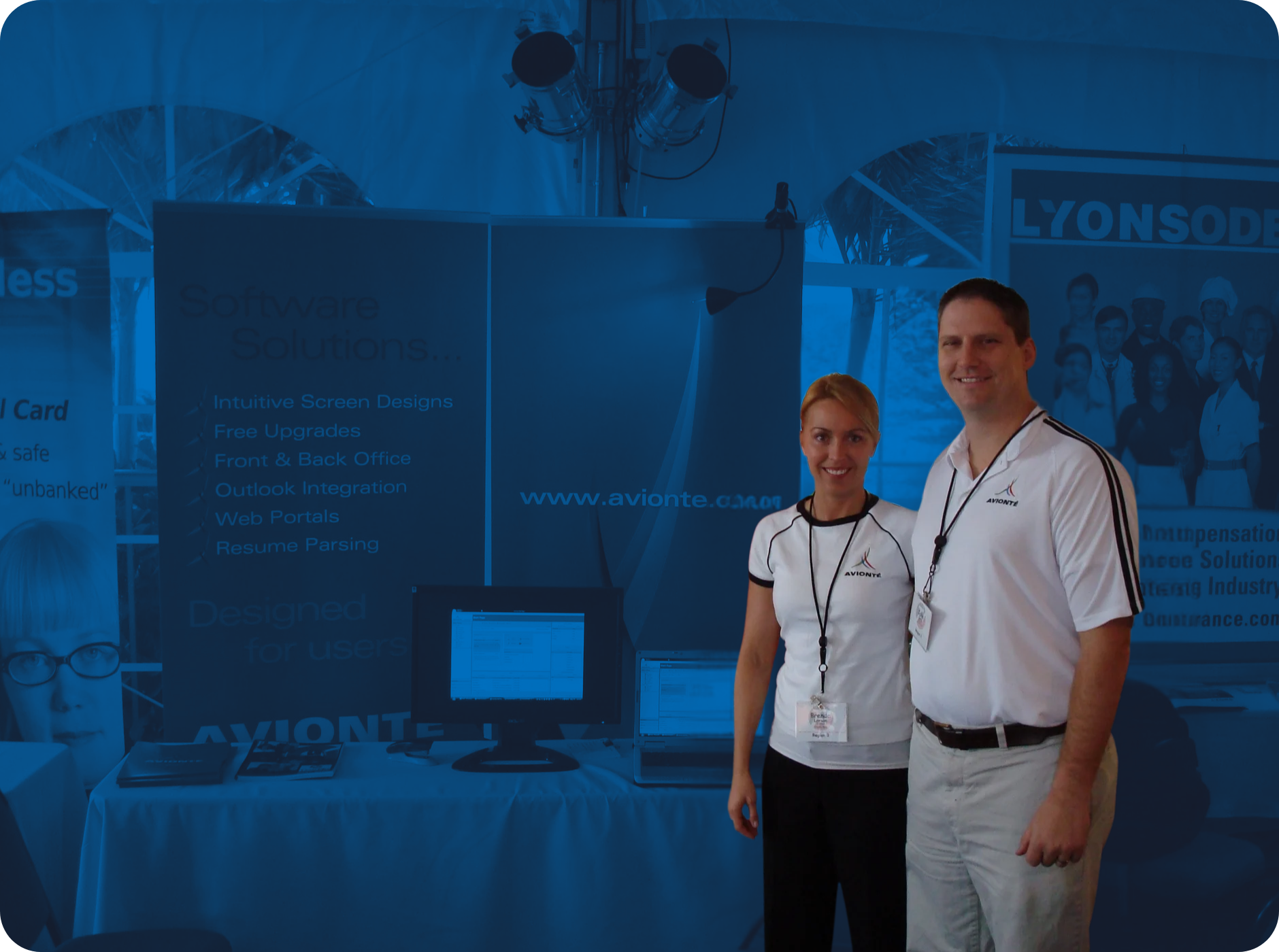
Reflecting on 20 years of Avionté with John Long
This is a partial transcript of the full conversation. Listen to the interview for the complete discussion.
Chris Ryan: Today, we're sitting down with John Long, founder and former CEO and co-chairman of the Avionté board, to talk about Avionté's incredible twenty-year journey from startup to industry leader. So, John Long, let's start at the beginning.
Maybe I should just ask you—what were you thinking? After all, in 2005, there were already major players in the market like Bullhorn, Bond, and others. I think somebody actually told you you were crazy to start another software firm. What was it that you saw? What was the gap that made you believe there was room for one more staffing platform?
John Long: I'm not sure if it was as much a gap as maybe we were just dumb. It might have been one of those periods where this is what we knew how to do and what we wanted to do.
We loved our customers. All four of us were over at a company called TempWorks and we were doing really well. We were rocking it. And we thought we could do it better and be more focused on our customers.
We loved the space. We'd built great relationships. We just thought we could do it better and have it under our control.
Looking back on it now, we were pretty crazy. I don't know if you've heard the story or not, but our investment dollars were nineteen hundred bucks a month for six months for four guys. That was about forty-three grand total—that was the total amount we had scraped together to start a staffing software company.
That's crazy, right? I mean, that's not enough. But we loved this industry. We knew the industry very well, and we wanted to give it a shot.
Chris Ryan: Wow. I mean, it sounds like it was about paying your lease for an apartment. So four people came together, you're each pooling a little money, and you're starting to write some code. When did you land your first major customer and why did they choose you over the competition?
John Long: It was all about the relationship. The little-known fact is the first actual contract was a company called Lifestyle Staffing in Madison, Wisconsin. Now this is a former—and still is as far as I know—TempWorks customer.
A guy named John Repzik, who is a great guy, ran it. I'd spent a lot of time with him over at TempWorks, and he was pretty innovative. He wanted more from software. So when I brought up the idea of starting this company, he was pretty excited about it.
We had an agreement that every quarter, he would pay me—I think it was $3,250—for showing them progress. Every quarter I would hop in my little Nissan Altima and drive down to Madison, Wisconsin. We had no money, so there was no notion of flying down or anything else like that. I would drive down there, meet up with them, show them the progress we'd made, and then at the end, I'd get a check.
Now, here are a couple of fun anecdotes. The first one was he didn't always show up. There were often times when he would not be at the office, but I had no choice. We needed the money, so I would sit in his office for hours—literally hours.The receptionist would come out and say, "Hi, he's really sorry. He just can't come in today. He apologizes, but you should head out." And I was like, "No, that's okay. I'll just stay right here." This was before they asked, because we had no choice, right?
So I would stay, and then I would show off all the progress we'd made. Then I'd be waiting for the check, and he would be like, "Ah, okay. I'll just mail that check to you." And I'd be like, "No, I'll just wait here." I'd ask him to go over to his payroll person and get a check cut, and that's what I would do—I'd just sit. And then I wouldn't be able to leave till maybe five or six o'clock at night, and it was way too expensive to stay in a hotel, so I'd drag my butt all the way back.
It was very much about determination—there were just no other choices. But that is the root of where our theme song came from: "Lose Yourself" by Eminem. I'm a huge Eminem fan, of course. But if you ever listen to the lyrics of "Lose Yourself," it really is cool. The main lyric that everybody thinks of is "you have one shot." Are you gonna take it? It goes through his general life, but the theme for all of us is: Don't miss your shot.
It's not as dramatic as there's only going to be one opportunity for everybody. But every single person has those moments, has those forks in the road where they step up and say, "You know what? I'm going to go give this a shot." That song periodically would come on the radio. I was too cheap to have CDs or anything of that nature, but often it was on the radio on the drive down, that four-and-a-half-hour drive, and that became my theme song.
Chris Ryan: When you were driving down, did you ever stop to think, "This is crazy," or was it better just not to think?
John Long: Yeah, it was crazy. It was challenging. It was tough. There were many, many times where it's just a tough deal.
When I started my career, I was in paychecks, and that's where I learned the back office and the payroll processing. I did well there and got promoted. At the end, I was able to have a position with Wells Fargo in their payroll department. It was a nice bump in salary. But I also had this other position as the second employee hired at a small software company called TempWorks. All my friends—and more relevantly, my parents who are teachers—said, "Take the Wells Fargo job. That's fantastic. Get into the corporate world and grow there." They'd ask, "What is this company? Does it even have an office? What does it do?"
I took the leap of faith there. There are a lot of points where you go into the unknown, but you go with purpose. You trust what you're doing, believe in yourself, and go make it happen. It was the best decision ever in my life. Well, it was the second best. Maybe the third best. I probably should mention the wife.
But starting Avionté was a leap of faith in that same way, because that's not a lot of money. There's a lot that could go bad. There were times when I took on all the financial burden to help out the other four founders as we were all going through this. It was so tough—I took a lot of the financial stress just so they didn't have to deal with it. We were in hundreds of thousands of dollars of credit card debt. You're staring it down and just having that gut reaction like, "What are we doing here? Why am I doing this?"
But I had faith, and we stuck it through. And then that SaaS valley of death became light at the end of the tunnel, and then it really got quite a bit of momentum, and it's been fantastic.
Chris Ryan: Tell us a little bit about the Great Recession. There's credit card debt and challenges associated with the economy. The Great Recession hit basically three years after you launched Avionté. How did you survive? And I'm curious—did the recession actually create opportunities for Avionté as a newer platform?
John Long: That's precisely correct. I often liken it to Forrest Gump, which is one of the better movies out there ever.
In Forrest Gump, if you remember the movie, he started with the shrimp boat. He got his boat, and he was out there with Lieutenant Dan, working and doing fine. They were doing okay, but there was a lot of competition. And then a hurricane came by, and they survived. It leveled the playing field for everybody else. A lot of things went out, and all of a sudden, they took off and were able to really run.
Now for us, it was clearly less dramatic than that, but there was a lot of competition that had big infrastructure. They spent a lot of money, and we were very lean. We had no money, so we were very, very lean. We were focused on the customers so hard. We didn't lose our first customer for I think six or seven years. That's the manic approach to the customer we had.
When the recession came through, it stalled out the development of the bigger players. They had to let go of a ton of staff. They didn't know how to deal with it, and this was normal for us. We were loving on our customers and continuing to add a customer or two a month and continuing to grow. The recession was obviously tough for a lot of people, but it really helped us out.
Chris Ryan: If you were used to operating in a very lean environment and others are used to operating with a lot of operating capital, I'm sure the recession came as a rude shock to them.
John Long: It leveled the playing field and jump-started us. It propelled us to the top.
Chris Ryan: Avionté started as on-premise software, but Software as a Service was just emerging. When did you realize that the cloud transition wasn't optional? And what were the biggest challenges in making the transformation from on-premise to Software as a Service?
John Long: We always offered both options. From the get-go, all original Avionté software was multitenant. It was designed so that every staffing company of ours on the hosted side would still be in a multitenant solution.
We always had that. I think our focus was more on listening to the customers and what their needs were. Some of the customers really wanted it on-premise. Some said, "Hey, let's try SaaS."
I'm a big fan of "Crossing the Chasm," the whole theory of the early adopters and late adopters. I think that's totally how it works. As staffing became more familiar with and comfortable with the benefits of SaaS, that’s what they wanted. It was an easy transition for us to just promote it and follow. It was more about listening to our customers and what their needs were as opposed to a big decision point per se.
Chris Ryan: Now Avionté is growing and evolving into more of a SasS platform. It's 2014. You're growing rapidly. You're on the Inc. 5000 list. You didn't necessarily need outside capital at that point, but venture funds are starting to notice you and offers are starting to come in. You faced a pivotal moment with your partners. Some of the partners chose to cash out and you chose to stay. Talk about that decision.
John Long: We never had any intention of selling. It goes a little bit back to being naive, where we just were focused on the customer. That focus was so manic that we often said we had no idea how large we got until we periodically put our head up and were able to see.
We had no intention of selling. We just kept our head down and kept going. It was not until an investment banker down in Jacksonville that had a connection not only to a customer of ours, but also to another staffing software company contacted us. She called and said, "Hey, I've got this connection." I was introduced to her by the customer. I always take those calls. I said, "Alright, let's do it."
Brenda and I decided to fly down to Jacksonville to spend time with this banker, got to know her, got to understand a little bit of the process, and she came up with a number that she thought Avionté would sell for.
I brought that back to the partners, and it's one of those things where I'm very respectful of people. When you can just sign your name and have financial security, it's really hard to stare that down. And I respect the three of them for making the choice they did. I'm from Wisconsin and the son of teachers. It was certainly enough money to be financially secure throughout their lives.
But to me, I don't know, it just didn't feel right. And I don't know if you've heard this, Chris—but this banker said, "Well, John Long, can you build us a deck?"
I was like, "Yeah, I mean, I'm pretty handy. I've done them before. Where do you want me to build this deck? Do you want two-by-sixes? Where do you want to have this?"
And she just looked at me. She was like, "PowerPoint?" And I'm like, "Oh, sorry about that. Yep. Got it."
We started doing the process, got a ton of interest, and did a lot of the dog and pony shows. I was attracted to Serent. I met one of their investment people at a local restaurant chain. We met outside, had a beer, and spent time talking. His name is John Cheek, and I got to understand who he was and why he was there.
But I had a fundamental question for him: "Alright, why are you here? And if you're promising all this stuff to help us out and run the company, how much are you gonna charge us to do that?"
He looked at me quizzically and was like, "No, that's just part of the deal."
The tipping point was when I understood that Serent was all in on providing talent and any resources we needed to grow as part of their investment. Whereas so many of the others would charge extra dollars. They had fees on top of it. They would say, "Yes, we're going to send this person. We're going to pay them several hundred thousand a year," and blah blah blah. So that was the tipping point for me with Serent. They believed in their values. That was important to me. I love this company. I love the customers. I wanted to feel that connection, that determination, that purposefulness of values.
We chose Serent. They came back with the number that the banker had thought of, which was kind of fun. Then we presented it to the other partners. And I remember the morning of closing, I told them—I won't use the exact term, but I said, "Fellas, you're crazy. You're crazy to do this." But I'm respectful of everybody in different positions, and so I certainly went along with it.
My viewpoint was that if there are so many people as smart as the Serent folks that want to invest in this company, where on earth are we going to come up with a better investment? Why wouldn't we want to continue to bet on ourselves?
I love the company. I love the space. The team was fantastic. These are lifelong friends. We just didn't want to leave, and so we stayed in.
Chris Ryan: Ultimately, the compatibility of your values with Serent made that relationship possible. Your allegiance to your customers and to the team kept you with Avionté. Because I was going to say it's not easy staying with a company and growing. It's fun to start up a new company, but once you reach a certain size, it takes hard work. There definitely are challenging times, but you decided to stay.
Talk a little bit about what became possible because Serent was now in the stable. Obviously, they helped with acquisitions, and we can talk about that. But what did Serent enable you to do that you couldn't do before? You already had a successful software company.
John Long: It's a great question. The straight answer, of course, is a lot.
Let's tie those last two comments together because you're right about the growth of an adolescent company and the differences from startup to building and scale. You're one hundred percent true. And everybody, including myself, has different skill sets, and some are less applicable to a company going through different stages. My skill sets were more for the small and midsized companies.
The first thing is that Serent allows the ability to hire somebody like yourself. I would not have been able at the time, given how we were growing, to be on the radar for a Rishabh or yourself. Without that financial backing, without the seriousness, purposefulness of how we're going, and ability to scale, that wouldn't have been possible. We would have slowed down our growth. We would have been good, but we would not have been able to accelerate like we did. We just couldn't do it otherwise.
The second part is that I didn't really understand how important the software was to the customer. I knew it, and I was passionate about it. Especially partnerships—everything the staffing company does should be going through the system. I really didn't understand how big that part was. It touches everything. I think Serent did a really nice job on actually saying, "Hey, how do we make it better and more impactful for the customers?" Kevin Frick, our chairman, his big thing is to delight the customer. How do we delight the customer and just focus on that?
I think the third part is from a technological perspective, Serent understood what other software and technology companies had done and are doing and they were able to open my eyes a little bit more about what is possible. How do you really streamline and scale the product, not just for revenue's sake, but to provide a better experience for the customer? That's what drives me and always drives the team. I think Serent did a nice job there as well.
Chris Ryan: With Serent coming on board, Avionté was able to make a number of important strategic acquisitions—COMPAS, WorkN, and Simple VMS. And you also had the opportunity to build out an API infrastructure to enable partnership programs and third-party integrations. What do you feel are the most important aspects of those acquisitions and the API? What do you think has really moved the needle for Avionté customers?
John Long: I think it's been critical. There were a lot of acquisitions. It's another area that we were able to do with Serent. Left to my own devices, there would not have been any M&A strategy at all, whether it's for the current providers or the enhancements to the technology. Serent helped us with that.
Each of those three acquisitions that you mentioned—COMPAS, WorkN, and Simple VMS—had different viewpoints or different benefits to it. COMPAS brought us a front end that was better for the rest of the world. We were focused on clerical and industrial. Our system wasn't overly web-based. It didn't have a good flow to help out on professional and IT. So that helped us elevate that side of the business.
WorkN brought in the mobile strategy, which I had not done. I was comfortable with a responsive design website, and they came back with other plans. They said, "No, there's a whole world here that we can do better."
Simple VMS is amazing software that bridges the gaps between an employer's perspective and the staffing industry, and it's something that enhances our product.
Chris Ryan: Of course, some would say, "Well, why not just build with APIs?" From 2015 on, I think Avionté now has over a hundred—I think 105, 106—software integrations and we're adding twenty or thirty every year. This ecosystem has been an important part of the outgrowth of Avionté.
John Long: It really has. I had no idea when we started this. That is the benefit of getting people—Scott Poeschl, the whole integration team, the development team—to build out the strong API and create that marketplace. It's fantastic. It truly benefits the customers. Being able to have all of their data work between the different sources is a game-changer for staffing and the staffing industry.
Chris Ryan: Let’s talk about what I describe as the modern era of the last five years. In 2020, it was a tough year. The COVID pandemic was underway. April 2020 was a scary time for the staffing industry. Suddenly, we saw employment plunging. But it was at that point that Avionté also brought in a new CEO, Rishabh Mehrotra. And between 2020 and 2025, the company has made extraordinary progress in terms of revenue growth and moving to cloud infrastructure. Avionté is now emerging as a major leader in the industry, second only to Bullhorn. Talk a little bit about Rishabh’s legacy and why he was so important for Avionté and its evolution.
John Long: Just a minor point—we're second to Bullhorn only in size. In terms of quality and importance, of course, we're number one. So, you know, we're second only in size to them. I'm kidding.
But 2020 was brutal, right? It was very, very tough for the country. So many people were affected dramatically by COVID. I had stepped down by then, so I wasn't sitting in the chair, but I was on the board and still am on the board.
For me, I wasn't as scared. I knew this industry would be the first one to come back. I knew that the effects, these months-long effects were temporary at best. I remember one of our board members was saying, "Hey, let's instead of talking about fat that we can trim, I mean, we need to be cutting limbs off. Which limbs do we want to cut off?" And I was like, "I just don't believe it, folks. I just don't believe it."
I started something I called the Avionté RAW, or Real Analytics Weekly. I went in to pull all of our customers, all of the assignments, the data that was being done, the payroll, averages, everything. I would make very low-level graphs. Chris, with your background, this is stuff you were doing probably in like third grade. You would have been very disappointed in my calculation process, but it was crystal clear about what was actually happening because we could pull same-source sales. It had to be people with us longer than a year. I didn't add in any new customers that were going live, so it was a very consistent baseline. It measured a lot of assignments, new applicants, hours worked, their pay rate, the bill rate. Of course, these graphs showed these stats plummeting off of a cliff.
But I would do it every week, and it was not that long before it absolutely started to level off. That was before we had to do major cuts because then it was like, "You know what? This actually might be okay. We're gonna recover." And then it started to go up every week.
I think we saved ourselves from some critical mistakes where we would have let go of talent that we didn't want to let go of. We certainly had to let go of some, but that was an important period.
Chris Ryan: One of the fascinating things about that period is that Avionté, because it is both a front- and back-office end-to-end platform, probably had better economic data than almost any other company in the country at that moment. Because we could literally look at staffing payrolls week to week and no other company had that kind of insight.
John Long: Exactly. Nobody else had that. You hear about ADP on the news and their index—that's only on the back-office side. They cannot say how many people were applying for a job. They can't say how many new jobs there were. They can't show both the employment people are interested in and how many new orders were coming through and how many people were starting. They don't have that data. It's a unique position.
When Rishabh came in, he was just a game-changer in general. This guy was so impressive in so many different ways. But one of the things I liked about him—I was worried that somebody, an outsider to the staffing industry wouldn't really understand the staffing industry. It is a beautiful industry. It's people-driven and people-centric.
People that run and work in the staffing industry truly want to give meaningful work to people. And it often gets a bad rap, and it's viewed as—there's certainly some bad apples. But in general, it's a beautiful industry that creates opportunities for people to get to do meaningful work.
And Rishabh came in and understood it. I think it touched him. He understood it. And then he took his background and created the vision of where we needed to go and asked how do we enhance that? How do we pull more from the entire life cycle of employment? How do we bring together the employers all the way to the employees? He was the one that architected many of those key acquisitions that you talked about. He saw where it needed to be. And Rishabh just brought a verve, a life to us that made a big difference and really put us on a path to growth.
Chris Ryan: An interesting thing about Rishabh as well was his emphasis on leadership and mentorship, particularly of some of the younger Avionté associates. I'm fascinated about the extent to which it feels like some of Rishabh’s points of view around leadership and growth have stuck with the company even though he's no longer with us. And that includes some people who started with Avionté back at the beginning. It's exciting to see that growth in the organization overall.
John Long: For sure. He touched so many lives, and when you get close to somebody as great as he was, it does have a positive effect on everybody. It's the rising tide lifts all boats mentality. He made people around him better.
You know, it gets a little sentimental, but if I'm looking back on the twenty years—and I can't believe it's been twenty years—one of the proudest things that I get excited about is that Avionté is a fabric. It's a mosaic. So many people, literally thousands of people, have contributed and been meaningful parts of this journey. There have been so many of these people that started their careers with us. This is their first job. They were working retail beforehand. This is their first job, or they were in a miserable career or job beforehand, and they got this opportunity to take off. To see their growth and how many are today's leaders, how many people have just continued to grow in staffing or even outside this industry—I just love every part of that. I think that's fantastic.
Chris Ryan: Yeah, that's a lot of fun. So as you think back, if you could go back to 2005, imagine yourself contributing that $1,900 a month to get that business going and you're in your Nissan Altima. If you were on one of those rides back home in your Nissan Altima, if you were to imagine what Avionté has become, what would surprise you the most? And what is the one thing that you might have gotten wrong about the journey? What has all of this taught you?
John Long: Yeah, there are many different ways to answer this, and it has been the most fun in my life. It is the most meaningful part. Here's a little anecdote—I'm a Green Bay Packer fan, being born and raised in Wisconsin, and Aaron Rodgers was reflecting here recently, just talking about how meaningful his time in Green Bay was. Green Bay created the scenario for him to be where he is today. I feel that with Avionté as well. This is the best time. I love every moment of it.
To answer your question, I think the biggest thing would be size. When we started this, we never really thought through the size of the company. It was never a goal to get to X millions or X number of customers or anything like that. We knew there was a problem. We thought we could do it better. We loved up on the customers, and we just started the journey.
But at the time, the biggest customers were at ten million in revenue. And so that was kind of the high point. And I remember telling a lot of people, "It is impossible. The total addressable market—it's impossible to get a software company that's even twenty million dollars in this industry."
If I'm looking back, clearly, I was way off on size. I was way off on the growth potential and what was truly possible. Yeah, I was not even in the ballpark of where it could go.
Chris Ryan: Now that Avionté is this big, large, stable platform, we have enterprise-grade infrastructure and security. There are a lot of things we have to do in a very careful and thoughtful way to make sure that we are supporting our customers. Because now we're almost like the critical utility platform for a thousand or more staffing agencies. How do you keep entrepreneurial energy alive while keeping the maturity and the stability of the platform that are needed?
John Long: Yep. I think it's a blend. I love the entrepreneurial spirit. That is where I'm comfortable, and it just oozes from me. I love it a lot. So I do think it should continue. Avionté is in a good spot now where it has the scale, and there are certain things where entrepreneurial spirit isn't necessarily the best.
But where entrepreneurial spirit is the best and where I think we should continue to go is that it focuses on the customer. Instead of thinking of customers as blocks, like “here's a hundred customers or a thousand or the industry,” we need to have the team and development and product and everybody just focusing on Bob. Bob at XYZ Staffing, or whatever—we need to get it down to that specific person, that specific company.
To answer your question, it's about focusing so hard on that individual customer and what our products are doing for their needs. Not telling them, "Here's everything they need," but listening. What are the pains that they're in and how can we address it?
The subtle one is the upside-down triangle, and I know Rishabh believed in this as well, where your best innovations actually come from the people that are dealing straight with the customer. So the CEO, I like to think, is the least important person. They're there to support the managers who are there to support the staff, and the staff is there to support the customers. And the customers are at the top of the triangle. That's the most important.
Rishabh always said everybody's a player on the field, right? Everybody's on the field. Having everybody sit back and go, "I see a problem. I see a need. Be loud. Push for it." That's where innovation can really happen.
Chris Ryan: Wow. What's the energy inside Avionté like right now as you mark this milestone?
John Long: I think it's great. At least I know from my perspective it is. Obviously, we had that tragic event in August, and it just really shook all of us, particularly yourself and so many people that knew him for many years.
We had our Connect right after that, and I pushed—we had discussions like, "Oh, what should we do with this? How should we do this?" I remember being on the phone with you to just relive that conversation. It was a Sunday, I think. And we had that kind of, "Gosh, what do we do on this?" moment. But we all felt that he would want us to continue.
I'm actually thankful that it was that close. Having that Connect, that time where we can go back to customers and reflect on what Rishabh did for us and where the company is going brought us back to the most important thing. We have to continue to love up on the customer. I think that Connect gave us that closure. It gave me that closure that said, "That sucked before. But you know what, we're going to be okay, and this is why we're here. This industry is fantastic. These customers are fantastic. This is why we're here."
I think that was the start of a really good energy and then we had a great show season. We had Staffing World and also all of the other state shows. We had a lot of good momentum on product development. And I think it shows in us here in Q3 having the biggest sales quarter ever. There's a ton of momentum and a ton of people going like, "You know what? We're getting back to the basics. We're still following Rishabh’s vision, but there's a ton of little things that we could just do."
And I think that goes back to what I'm talking about—the entrepreneurial spirit where you're empowering your staff to say, "Hey, what problems are our customers facing right now? And let's deal with it. Let's just go do that." I think that's pretty invigorating.
Chris Ryan: So final question. I want you to be professor, prophet, and prognosticator. The staffing industry has changed a lot over the last twenty years, and it's going to change even more. We have artificial intelligence coming in, a new age of automation, and jobs are changing and evolving. What are you excited about over the next twenty years for staffing? What do you look forward to?
John Long: That's a big question for sure. The staffing industry in general, I believe, will continue. You're so right. It certainly has changed a ton over the last twenty years, and it would be naive to believe it won't change a lot over the next twenty years. You've done a ton of research on the dynamics of employment in general, aging population—we've had several discussions on your viewpoints, your correct viewpoints, of where that’s going. The staffing industry will change.
I think, though, at the core, it's still a people business, and I think that's still going to trump everything because at the end of the day, people want to work with people they like. They need it. People need meaningful work. We're not going to be in a situation where that's not true.
I feel like it'll change, especially around the edges and what job types are in demand. If I had to come up with one change where I think we'll see more traction, it's going to be the fractional side of the C-suite. Right now, you don't see too many fractional C-suite people, especially like CFO, CMO. But I think that's going to be prevalent. I think that will really see a boost.
But I think the beauty of it is that the staffing industry will just adapt. I don't have great answers for it, but I think it'll be adapting, and I'm excited for Avionté to lead the change.
Chris Ryan: I mean, the one thing I've learned is never count the staffing industry out. The agility and the adaptability of this industry is truly astounding. And I have to say that at the end of the day, we are defined by our relationships and that is definitely true about staffing. It's true about Avionté.
So, John, thank you so much for sitting down and doing this interview. This has been fun and thank you for sharing your insights and thank you for founding Avionté. It's been a lot of fun.
John Long: It's been a lot of fun. It's truly been an honor. It's truly been a blessing to see the difference that Avionté has made. It's something that still makes me smile.
HISTORY
20 Years in the Making
From a bold startup vision to a driving force in staffing technology, Avionté's story is one of innovation, resilience, and unwavering commitment to our customers.
Explore our timeline to see how far we've come, and where we're headed next.